Table of Contents
If you’ve ever held a finely crafted custom metal medal, you may have wondered how it goes from a design file to the finished product.
The process can include artwork preparation, mold making, casting or striking, polishing, plating, coloring, ribbon assembly, inspection, and packaging.
How each medal is made depends on its shape, size, relief, colors, finish, and intended use. Here’s a look at the typical production process.
1. Preparing the Medal Artwork
Every custom medal starts with the artwork.
You can provide a finished design, or simply send us a logo, sketch, photo of an existing piece, or a few ideas you want included.
Before production begins, we usually confirm:
- Medal size and shape
- Front and back artwork
- 2D or 3D relief
- Metal finish
- Enamel or printed areas
- Logo and text placement
- Loop and ribbon attachment
Once the basic details are clear, the artwork is adjusted for production and a digital proof is prepared for approval.
This is the best time to check names, dates, spelling, dimensions, logos, and major design elements. Once the mold has been made, changing the main relief or structure may require a new mold, which can add both cost and production time.
2. Making the Medal Mold
After the artwork is approved, the mold is created.
For die-cast and die-struck medals, the mold defines the final shape, lettering, logo details, recessed areas, and raised relief.
A 2D mold works well for logos, text, borders, and simple raised or recessed details.
For portraits, buildings, animals, vehicles, or artwork that needs more natural depth, 3D relief can create smoother transitions and a more dimensional look.
Fine text, narrow lines, and very small details also need to be checked at this stage. Something that looks sharp on a computer screen may not reproduce clearly in metal, so small adjustments are sometimes needed before production.
3. Forming the Medal
Once the mold is ready, production moves to the metal-forming stage.
Two of the most common methods are die casting and die striking.
Die Cast Medals
Zinc alloy is commonly used for die casting.
Molten metal is injected into the mold and allowed to cool, creating the basic shape.
Die casting works especially well for:
- Custom shapes
- Cutouts
- Complex outlines
- 2D and 3D relief
- Thicker designs
- Detailed or irregular shapes
This method is widely used for race, sports, and event medals because it offers more flexibility in shape and relief.
Die Struck Medals
Die-struck medals are made by pressing the design into metal under high pressure.
This process works especially well when the design relies more on metal texture and relief than color.
Typical die-struck designs include:
- Logos
- Text
- Seals
- Simple relief
- Antique finishes
For a more traditional look with strong raised details and a solid metal feel, die striking is often a good choice.
4. Trimming and Polishing
Freshly formed medals may still have rough edges, excess metal, or small burrs left from production.
These areas are trimmed, polished, and smoothed before plating.
Surface texture can also be used to create contrast. Raised logos or lettering may be polished, while recessed backgrounds can be sandblasted or given an antique treatment.
For medals that rely heavily on metal detail, this contrast often does more for the design than adding extra colors or decorative effects.
5. Plating the Medal
After the medal has been cleaned and polished, it is usually plated.
Plating adds the metal finish to the surface and helps define the overall look.
Common finishes include:
- Gold
- Silver
- Copper
- Black nickel
- Antique gold
- Antique silver
- Antique bronze
Bright gold, silver, and copper are common for sports, racing, and award medals.
Antique silver, brass, and bronze are often used for military, police, firefighter, memorial, and traditional designs because the darker recessed areas help the raised details stand out.
Antique finishes are especially effective for designs with a lot of lettering or deep relief.
6. Adding Color and Printed Details
If the design includes color, it is usually added after the metal has been formed and plated.
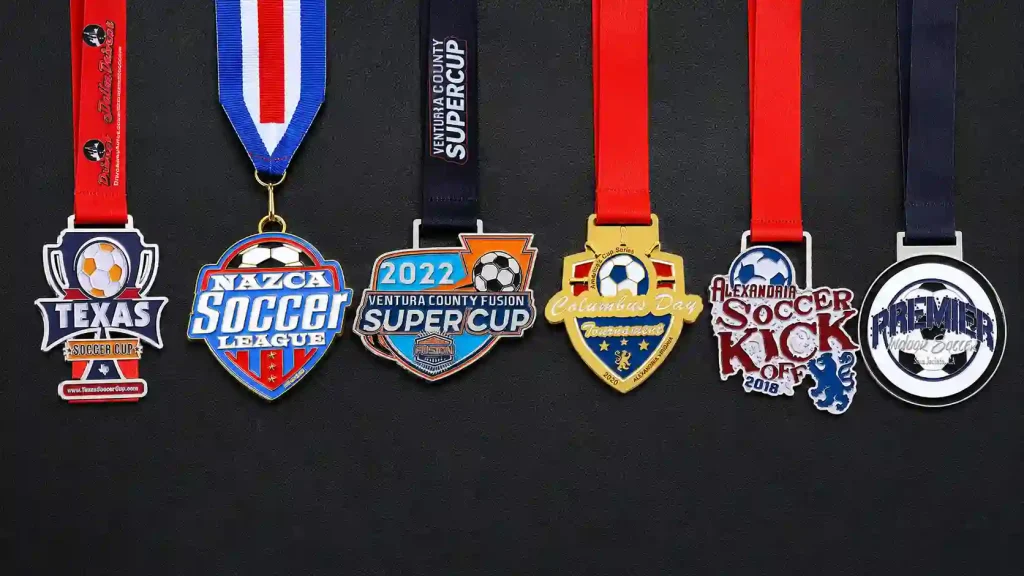
Common options include soft enamel, hard enamel, and printing.
Enamel
Enamel is filled into recessed areas created for color.
Soft enamel leaves the metal borders slightly raised, giving the finished medal a noticeable textured feel.
It works especially well for:
- Team logos
- School colors
- Event graphics
- Lettering
- Sports designs
Artwork with clean outlines and clearly separated colors usually works very well with enamel.
Printing
Some artwork is better reproduced with printing instead of enamel.
Printing is useful for:
- Gradients
- Photographs
- Very small text
- Detailed illustrations
- Complex multicolor artwork
Trying to convert these elements into enamel can remove detail or simplify the original design too much.
Printing and enamel can also be combined. For example, the main logo may use raised metal and enamel while a gradient background or fine detail is printed.
7. Adding Special Finishes
Additional finishes can be added when they fit the design.
Common options include:
- Sandblasting
- Glitter enamel
- Transparent enamel
- Glow-in-the-dark enamel
- Epoxy coating
- Sequential numbering
- Laser engraving
- Edge text
- Cutouts
Using more finishes does not always improve the final result.
A design with deep 3D relief, for example, can quickly look too busy when combined with multiple enamel colors, glitter, transparent enamel, and printing.
We usually recommend keeping the focus on the strongest part of the artwork. If the relief is the main feature, it should remain easy to see. If team colors, sponsor branding, or event graphics are more important, enamel or printing may be the better choice.
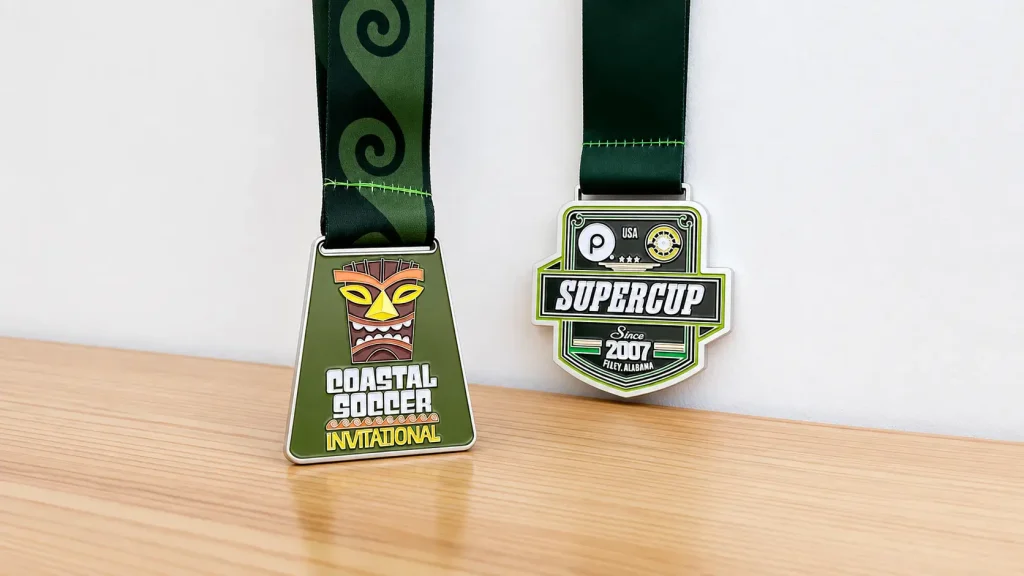
8. Attaching the Ribbon
Once the main piece is finished, the loop and ribbon are attached.
Custom medal ribbons can include:
- Different ribbon widths
- Custom colors
- Printed logos
- Event names
- Sponsor logos
- Dates
- Custom text
For races, sporting events, and school awards, it becomes part of the overall design rather than simply a way to wear the award.
Event names, dates, sponsor logos, and other branding can be placed on the ribbon instead of crowding the main design.
9. Quality Inspection
Before packing, finished medals are inspected for production issues.
Typical checks include:
- Correct medal size
- Clear logos and lettering
- Consistent plating
- Scratches or surface defects
- Missing or overflowing enamel
- Printing alignment
- Secure loops and attachments
- Correct ribbon installation
For 3D medals, the relief is also checked to make sure portraits, buildings, animals, vehicles, and other sculpted details have formed properly.
Pieces with obvious plating, color, printing, or structural defects are removed before the order is packed.
10. Packing the Finished Medals
After inspection, the medals are packed for shipping.
Most bulk orders are individually packed so the metal surfaces do not rub against each other during transit.
Depending on the project, packaging options may include:
- Poly bags
- Velvet bags
- Presentation boxes
- Custom packaging
The finished medals can then be shipped to schools, companies, clubs, military units, race organizers, or event venues.
Not Every Medal Uses the Same Process
Not every custom medal goes through every step above.
A simple antique die-struck medal may only require striking, polishing, and an antique finish, with no enamel at all.
A detailed custom race medal, on the other hand, may combine a custom shape, cutouts, 3D relief, soft enamel, printing, and a custom ribbon.
The right process depends on the artwork, budget, quantity, size, and how the finished piece will be used.
Choosing the Right Process for Your Medal
VeperPins has more than 20 years of experience producing custom metal products. Whether you have finished artwork or just a logo, sketch, or rough idea, we can help with design preparation, production recommendations, manufacturing, packaging, and shipping.
If you are working on a race, school event, company award, tournament, or other project, send us your artwork and basic requirements. We can review the design and recommend the production method that fits it best.