
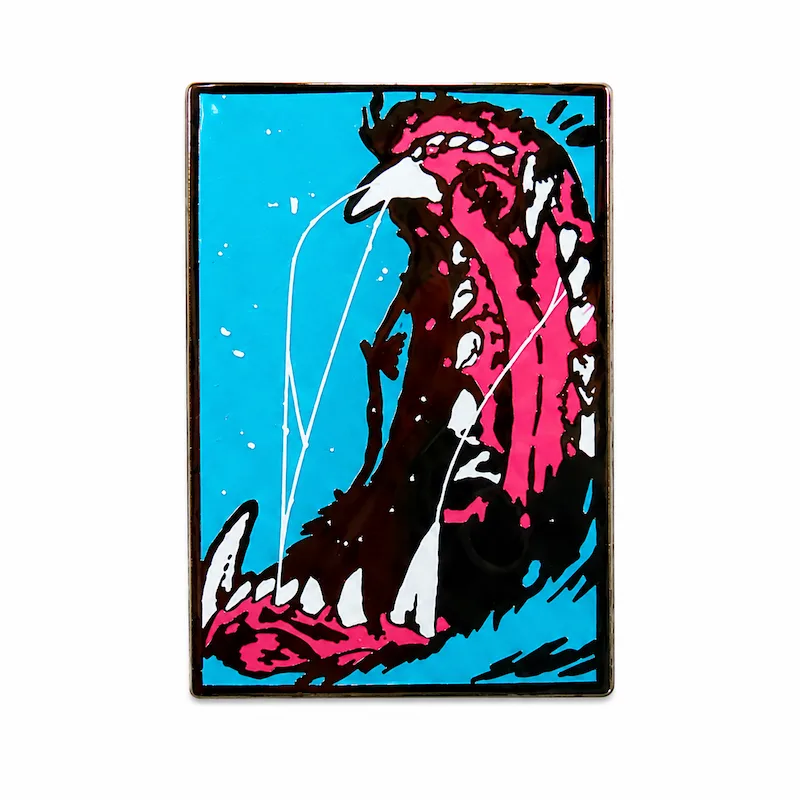
Why Order Custom Printed Pins?
The key advantage of custom printed lapel pins lies in the balance between complex design reproduction and production efficiency.
For designs featuring gradients, shadow effects, or high-resolution artwork, printing technology delivers highly accurate color reproduction and faithful detail rendering, while significantly reducing production time—making it ideal for rush orders or time-sensitive projects.
In addition, printed pins are not limited to a single technique. They can also be combined with enamel processes. Enamel metal lines can be used to enhance structure and texture, while printing is applied to achieve complex colors and fine details, resulting in a perfect balance of visual impact and craftsmanship.
For pure UV printed pins, we usually recommend adding an epoxy coating on the surface. This not only enhances gloss and overall texture but also effectively protects the UV-printed areas, improving scratch resistance and helping prevent color fading.

Printing Methods We Use
Not every custom printed pin should be made the same way. Different artwork, surface height, color details, and production requirements may need different printing methods.

UV Printing
Best for full-color artwork, gradients, shadows, photo-style details, and larger printed areas.
UV printing works well for designs with rich colors, such as full-color artwork, gradients, shadows, or photo-style details.
If the design has a large printed area, or if some color effects are hard to create with enamel, this method is usually a good choice. It can be printed on enamel, metal, and even some raised areas, so it is often used for colorful or detailed pin designs.
But it is not perfect for every small detail. If the text is very small, the lines are very thin, or the artwork has a lot of tiny details, the edges may look a little softer when viewed up close. It may not look as sharp as screen printing.
That is why very small facial details, thin lines, or small logos are sometimes done with screen printing or offset printing instead.
Learn more about UV printed pins →
Screen Printing
Good for small logos, facial details, fine lines, thin outlines, and clean solid-color details.
Screen printing is better for small details that need to look clean and sharp, such as small logos, facial features, blush, shadows, fine lines, and thin outlines.
But this method needs a fairly flat surface. It is not only the printed area that needs to be flat. The area around it also cannot have raised metal that is too high.
Otherwise, the printing tool may not press down properly, and the printed edge may look messy, or some parts may not print well.
So even if a design looks like a simple small detail, it may not be suitable for screen printing if there is a high metal line right next to it. In that case, offset printing may be needed.
The ink layer is very thin, so it does not add much thickness to the pin. It gives a smooth and clean look. Screen printing is better for solid-color details, but it is not a good choice for gradients.
For pricing, it is usually charged by the number of printed colors. More colors mean a higher cost.
Learn more about screen printed pins →
Offset Printing
Useful for soft shadows, small gradients, smooth color transitions, and areas that are harder to screen print.
Offset printing is a type of transfer printing. Instead of printing the color directly onto the pin, the artwork is first transferred to a soft pad, then pressed onto the pin surface.
This method works well when regular screen printing is hard to do. For example, if the pin surface is not fully flat, or if there are raised metal lines close to the printed area, offset printing can usually handle it better.
It can also be used for small gradients, facial shading, soft shadows, and smooth color transitions, making the details look more natural.
The downside is the cost. Like screen printing, offset printing is usually charged by color, but it costs much more. In many cases, it can be more than twice the cost of screen printing.
That is why we do not use offset printing for every design. If UV printing or screen printing can do the job well, there is no need to add extra cost. We usually recommend offset printing only when the surface is tricky, the details need to be sharper, or the artwork needs a softer gradient effect.
Learn more about offset printed pins →
Combining Printing Methods
Different parts of one pin can use different printing methods for a cleaner and more balanced result.
Many custom printed pins do not use just one printing method.
For example, backgrounds, clothing, and large color areas can be done with UV printing. Eyes, mouths, small logos, and fine lines can be done with screen printing.
If some areas have height differences, or if the design needs softer shadows and gradients, offset printing can be used for those parts.
This way, each part of the pin uses the method that fits it best. The sharp details stay sharp, the soft areas look smoother, and we do not have to force one printing method onto the whole design.
This can help avoid blurry details, unnatural gradients, or unnecessary production costs. For custom printed pins, the best result usually comes from choosing the right method for each part of the artwork.