Table of Contents
Touring and selling merch can be frustrating when the show goes great, but fans walk over to the merch table afterward and see the same three things they always see: T-shirts, posters, and tote bags.
T-shirts are still one of the easiest things to sell, but once you start carrying multiple sizes, inventory gets complicated fast. Posters can be awkward too—they’re easy to bend, and fans have to carry them around for the rest of the night.
If you’ve just finished a new album or you’re getting ready for another tour, it may be worth adding a few smaller items that are affordable, easy to pack, and simple for fans to grab on the way out.
Pins, metal keychains, and patches don’t take up much room at the merch table or in your tour van. They can also pull directly from your album artwork, band logo, lyrics, or tour visuals. For fans, they’re an easy way to carry a piece of the music with them without spending $30 or $40 on another shirt.
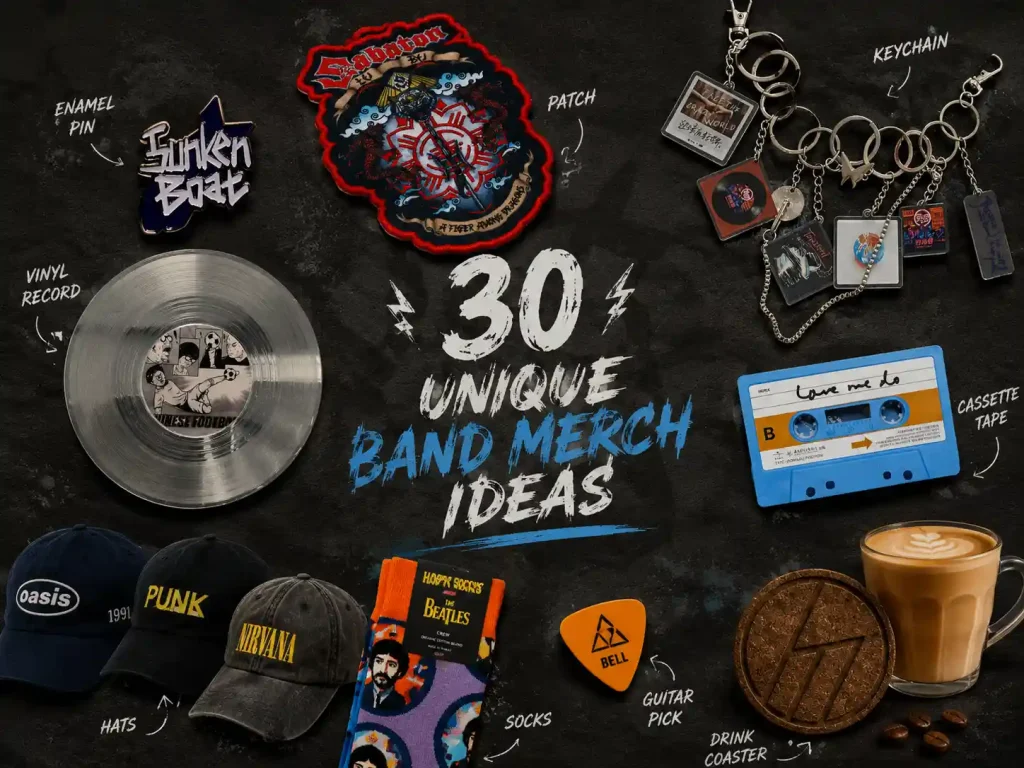
Here are 30 merch ideas for bands and independent musicians, ranging from easy, low-cost items to limited collectibles for your biggest fans.
Small Merch That Works Well at the Tour Table
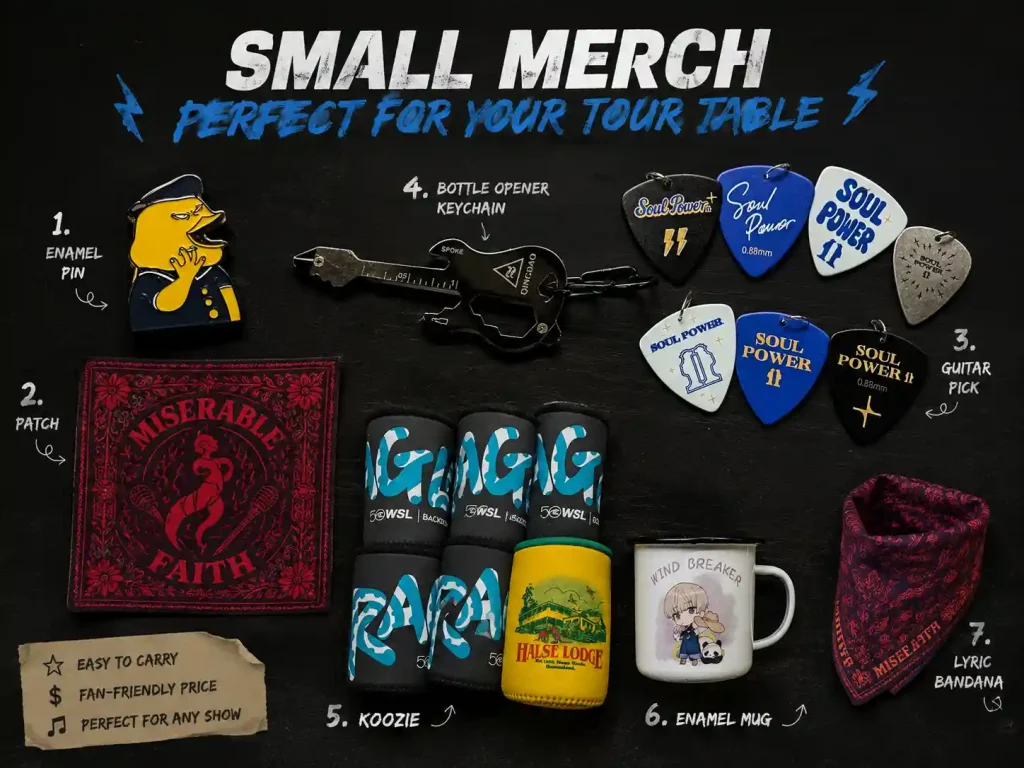
1. Band Pins
There’s a practical reason metal band pins have stuck around for so long: they hold up.
Fans can put them on jackets, backpacks, guitar cases, or festival bags and keep them there for years.
You also don’t have to limit the design to your band logo. Album artwork, lyrics, characters, tour dates, or tiny references only longtime fans understand can all become separate pin designs.
For fans who already collect music merch, pins are easy to store, trade, and slowly build into a larger collection.
2. Woven or Embroidered Patches
Patches have been part of Punk, Metal, Hardcore, and DIY music culture for decades.
Fans can sew them onto battle vests, backpacks, hats, jackets, or guitar cases, so they’re not just something that sits on a shelf.
If your design has a bold logo and simple shapes, embroidery usually works well. If it includes small lettering or finer details, a woven patch may be the better choice.
They also have one big advantage over apparel: no size runs to worry about.
3. Custom Guitar Picks
If guitar is a big part of your music, custom picks are an obvious fit.
They’re inexpensive to produce in bulk, barely take up any space on tour, and work just as well as a low-cost merch item as they do a giveaway.
Print them with your logo, signature, album artwork, or a small graphic. You can also package three to five different designs together as a set.
4. Bottle Opener Keychains
Regular keychains are everywhere, so adding a bottle opener gives them a little more reason to stick around.
Keep the design simple. A clean band logo, mascot, album symbol, or recognizable icon usually works better than trying to squeeze an entire illustration onto a small piece of metal.
The easier it is to recognize from a distance, the better.
5. Koozies
Koozies are everywhere at festivals, bar shows, backyard parties, camping trips, and outdoor events in the U.S.
They’re not expensive collectibles, and that’s kind of the point. They’re casual, useful, and easy to throw onto a merch table.
Use your logo, a lyric, a tour slogan, or an inside joke your fans will immediately recognize. Once someone is walking around a festival holding one, your band name is moving through the crowd with them.
6. Enamel Mugs
For Folk, Country, Americana, Indie, and anything with an outdoorsy feel, enamel mugs often make more sense than standard ceramic mugs.
They already have that road-trip and camping look, and they’re less fragile when you’re moving inventory from city to city.
Try wrapping album artwork, a tour route, or a simple band graphic around the mug instead of just putting a logo in the middle.
7. Lyric Bandanas
Bandanas solve one problem every touring band understands: there are no S, M, L, or XL sizes to stock.
Fans can wear them around their neck, wrist, or head, tie them onto a bag, or even hang one from a mic stand.
Instead of dropping a logo in the center, use the whole piece. Lyrics, symbols, patterns, and album artwork can turn it into something much more interesting.
They’re especially good for summer tours and outdoor festivals.
8. Hotel Key Fobs
Old-school hotel key tags are perfect for bands with a retro, road-trip, desert, motel, or Americana aesthetic.
Turn the room number into an album number. Replace the hotel name with your band name. Put a song title where the room name would normally go.
The appeal isn’t that it does a hundred things. It looks like a souvenir someone brought home from a fictional motel somewhere along the tour route.
Turn the Music Itself Into Merch
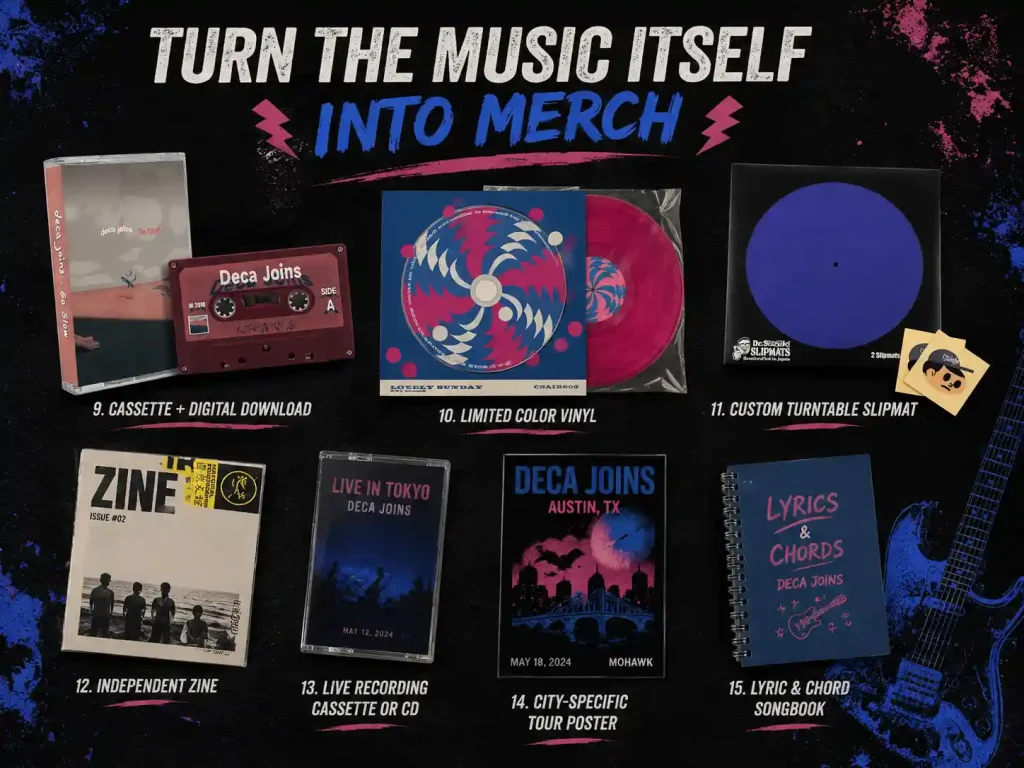
9. Cassette Tape + Digital Download
At this point, cassettes are often more about collecting than convenience.
That makes them especially good for Lo-fi, Punk, Synthwave, Indie, and other scenes where physical formats still feel connected to the music.
Use colored shells, custom J-cards, handwritten details, or alternate artwork, then include a digital download code.
Even fans who don’t own a cassette player may still want one as a physical piece of the album.
10. Limited Color Vinyl
If you’re already pressing vinyl, a limited color version can make the release feel much more special.
It doesn’t have to be complicated. Matching the vinyl color to the album cover, a song, or the overall visual direction is often enough.
For smaller runs, you can also number the copies or add a special insert to make them feel different from the standard pressing.
11. Custom Turntable Slipmats
Fans who buy vinyl usually own a turntable, which makes slipmats a natural extension of the record itself.
They also give you a lot more visual space than a pin or sticker.
Full album artwork, bold illustrations, typography, and large graphics all work well here. For DJs and fans of Electronic, Hip-hop, and beat-driven music, it also connects directly to how they listen.
12. Zines
A zine doesn’t need to look like a polished coffee-table book.
Actually, it’s often better when it doesn’t.
Handwritten lyrics, rehearsal photos, tour snapshots, unused cover ideas, notes from the band, messy sketches, and behind-the-scenes material can make it feel much more personal.
For fans who care about how the music was made, that can be more interesting than another polished promo photo.
13. Live Recording Cassette or CD
Some shows deserve their own release.
Maybe it was Chicago, New York, your hometown show, or the last night of a tour.
A small run of CDs or cassettes from that performance can become a great piece of location-specific merch. Use the poster from that night, a stage photo, or even the actual setlist as the cover.
For fans who were there, it becomes more than a recording. It’s proof of a night they were part of.
14. City-Specific Tour Posters
You don’t have to use the same poster for every date on the tour.
If the budget allows, pick a few important cities and work with local illustrators on a different design for each show.
The venue, date, city name, local landmarks, and even neighborhood references can all become part of the artwork.
Print them in small runs, then number or sign them. That immediately makes them feel more collectible than a single tour poster printed by the thousand.
15. Lyric & Chord Songbook
If a good number of your fans play guitar, piano, or sing, a simple songbook can be surprisingly good merch.
It doesn’t need to look like an official music textbook.
Lyrics, basic chords, alternate tunings, and a few notes about where each song came from are enough.
Leaving in some handwriting or rough notes can actually make it feel more like a songwriter’s notebook than a generic sheet music book.
Wearable Merch Beyond the Standard Band Tee
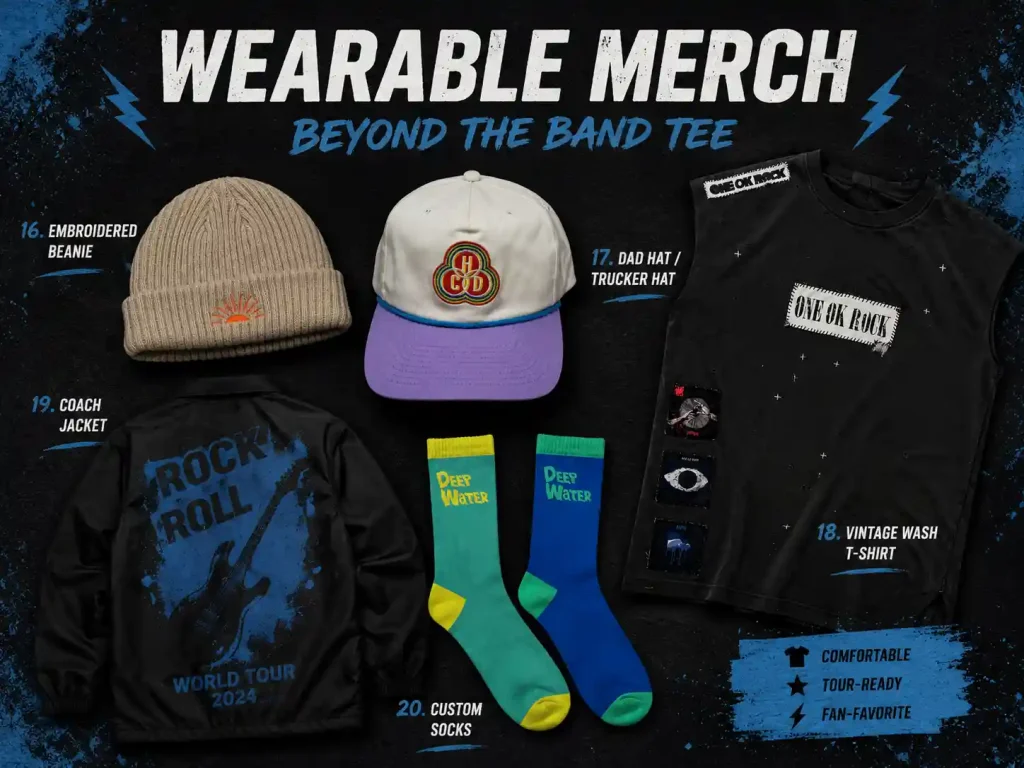
16. Embroidered Beanies
Beanies work especially well for fall and winter tours, and you usually don’t have to deal with a full size run.
You don’t need a giant design either.
A small embroidered logo, initials, or album symbol on the cuff is often more wearable than a huge band name. Fans are more likely to wear it in everyday life, not just to shows.
17. Dad Hats or Trucker Hats
Hats don’t need to be overdesigned.
Pick a style the band would actually wear—dad hat, trucker hat, five-panel, whatever fits—and keep the front simple.
A small embroidered logo, band initials, or one recognizable element from the album is usually enough.
18. Heavyweight Vintage Wash Tees
T-shirts still deserve a place on the merch table. They just don’t always have to be a basic black tee with a logo on the chest.
Heavyweight blanks, faded washes, distressed graphics, old-school tour layouts, and bootleg-inspired prints can make a shirt feel more like something fans would wear anyway.
This works especially well if your visual style leans into the ’80s, ’90s, Grunge, Metal, Hardcore, or vintage bootleg look.
19. Workwear or Coach Jackets
If your merch table already has plenty of $10–$40 items, it can make sense to carry a small number of higher-priced pieces too.
Coach jackets and workwear jackets work well for that.
Keep the front clean with a small logo and use the back for the full tour artwork.
You don’t need a huge quantity. These are better suited to longtime fans who already own a few shirts and want something a little different.
20. Custom Socks
Socks don’t sound exciting at first, but there’s actually plenty you can do with them.
Repeat your logo across the fabric, use your band colors, or turn a small album graphic into a pattern.
They work especially well for Punk, Skate, Indie, Hip-hop, and streetwear-adjacent projects.
Sizing is also much easier to manage than shirts or jackets.
Turn “I Was There” Into Merch
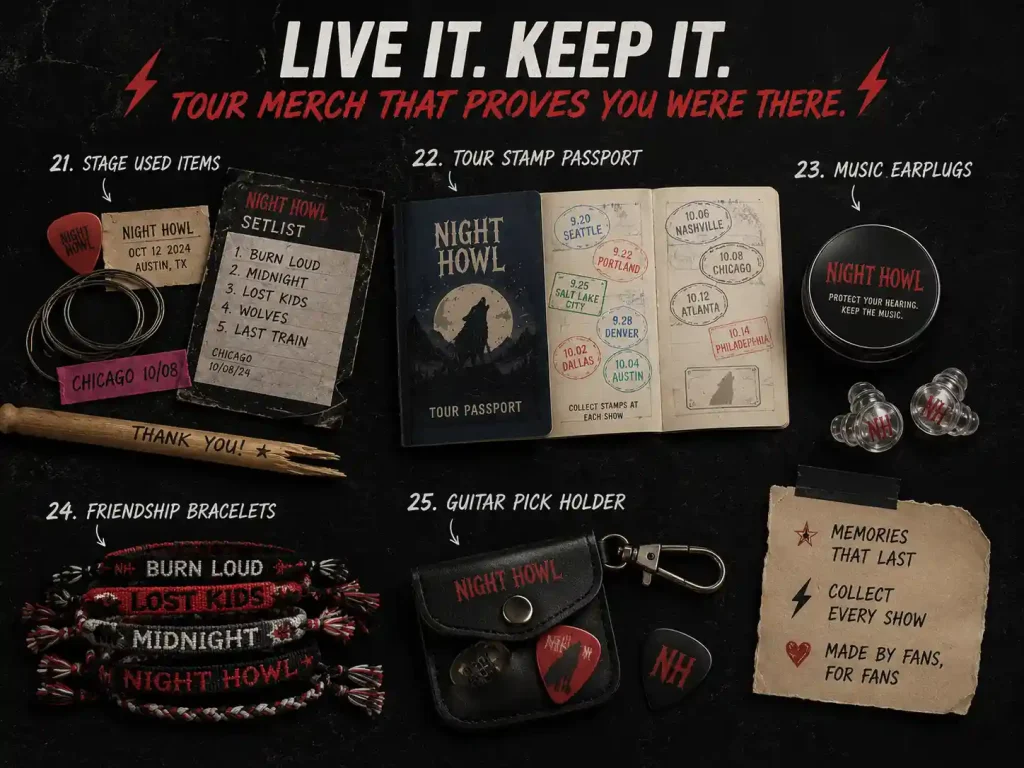
21. Used Stage Gear Relics
Some things are worthless to almost everyone and incredibly meaningful to the right fan.
Used guitar strings, broken drumsticks, picks played during a show, handwritten setlists, and other stage-used items can all become small collectibles.
Add the city, date, show, and a number to each one. That gives the object context instead of making it feel like you just tossed old gear into a bag.
This isn’t something you need to sell every night, but it works really well for anniversaries, final tour dates, hometown shows, and special events.
22. Tour Stamp Passport
If you have fans who follow multiple dates on a tour, give them a reason to document every stop.
Make a small tour passport and create a different stamp for each city. Every time someone comes to another show, they can get the next page stamped at the merch table.
The reward doesn’t have to be expensive. A special sticker, limited pin, unreleased demo, or small piece of exclusive merch can be enough to make it fun.
23. High-Fidelity Earplugs + Branded Case
Shows are loud, and earplugs are one piece of merch fans can actually use at the next show.
If your budget allows, offer reusable earplugs designed for live music and put your logo on the case.
You don’t necessarily have to manufacture the earplugs themselves. A custom metal or silicone case paired with an existing hearing protection product can still work.
Either way, it’s more useful than another item that just sits in a drawer.
24. Friendship Bracelets
The best part about friendship bracelets isn’t necessarily selling them. It’s trading them.
Song-title abbreviations, lyric references, album colors, inside jokes, and character names can all become different bracelet designs.
You can sell finished versions or put together DIY kits for fans to make their own before the show.
If your fan community already likes interacting with each other, this kind of merch can easily turn into part of the live experience.
25. Guitar Pick Holders
If you’re already making guitar picks, you can take the idea one step further.
A small leather or rubber pick holder that clips onto a keychain or guitar bag can hold two or three picks.
It’s genuinely useful for musicians, and even for fans who don’t play, it still feels more connected to music than a standard keychain.
You can also include one exclusive pick inside and sell the two together.
Turn the Band Into More Than Just Music Merch
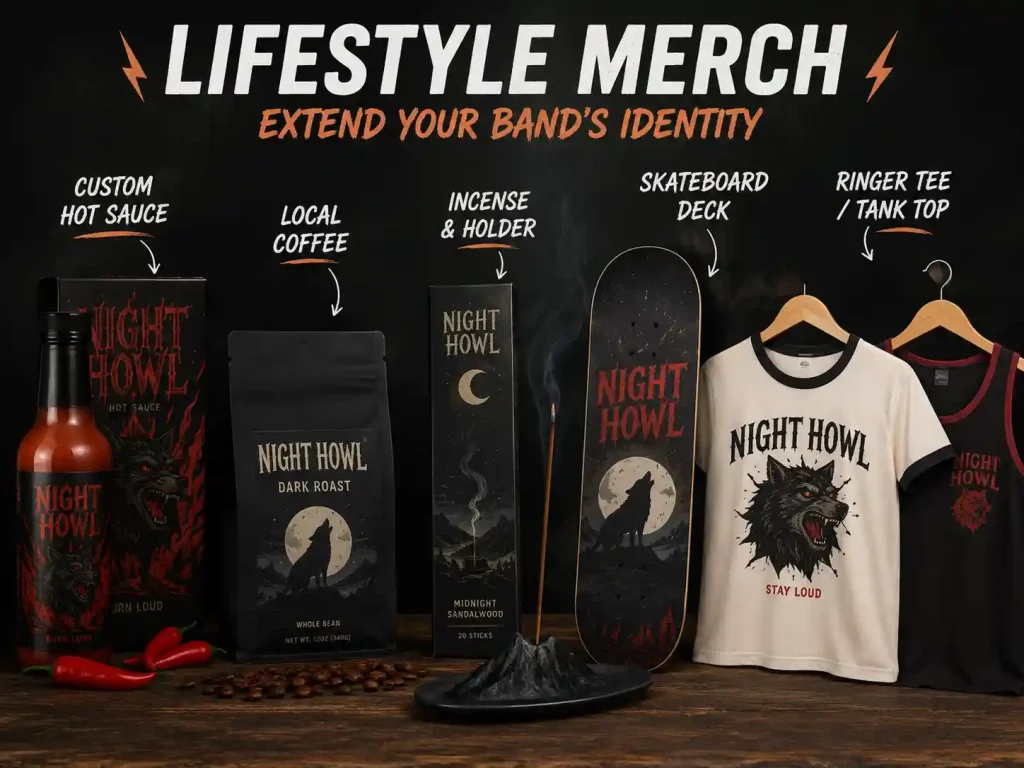
26. Custom Hot Sauce
Some bands can get away with merch that barely looks like merch at all.
Hot sauce is a good example, especially if your band already has a strong visual identity, song titles, or recurring jokes that fans know.
Instead of just sticking a logo on a bottle, build the product name and label around a song, lyric, character, or inside joke.
Since food comes with shelf-life, labeling, and shipping requirements, working with an established hot sauce company is usually much easier than trying to produce it yourself.
27. Local Coffee Collaboration
Touring means moving from one city to the next, so coffee can be a great way to bring a little local identity into your merch.
Partner with a roaster in your hometown, or create a limited blend around a new album or tour.
The bag can use your album artwork, while the roast name can come from a lyric, song title, or tour theme.
Done well, it feels like a real extension of the record instead of regular coffee with a band logo slapped onto it.
28. Incense & Holder
Scent-based merch isn’t right for every band, but for some music it makes complete sense.
Psych-Rock, Ambient, Dream Pop, Neo-Soul, Experimental, and other atmosphere-heavy genres can use scent as another way to extend the world around an album.
Pair the incense with a simple metal or ceramic holder and the whole thing feels much more intentional.
29. Skateboard Decks
Hardcore, Hip-hop, Punk, and skate culture have overlapped for a long time.
A skateboard deck also gives you a huge canvas for album art.
It doesn’t even need to be ridden. Plenty of fans will hang a limited deck on the wall like a long-format art print.
Because decks are larger and more expensive than most tour merch, they usually make more sense as a limited release than something you haul to every show.
30. Ringer Tees & Tank Tops
There’s nothing wrong with going back to T-shirts as long as you change the format.
Tank tops can work well for summer tours. Ringer tees are great when you want a ’70s or ’80s feel.
The contrast between the collar, sleeves, and main body of the shirt can become part of the design itself, so you don’t always need a huge graphic across the front.
If you’ve already released five different black band tees, switching the garment itself can make the next merch drop feel less like the last one with new artwork.
When Should Musicians Start Making Merch?

If you want merch ready for a new single, album, or tour, don’t leave it until a few days before release.
Custom products often need time for artwork approval, samples, production, and shipping. For items like pins, patches, and keychains, starting at least four weeks ahead gives you a much safer window. Vinyl, special packaging, and more complicated limited releases may need considerably longer.
The release date itself matters too.
According to Spotify for Artists, more than half of merch clicks tied to a new release happen within the first 24 days after the music comes out.
In other words, when fans are most excited about a new song or album, your merch should already be available.
Ideally, the merch goes live around the same time as the release. If you can, start teasing it beforehand with social posts, product photos, or preorders so fans already know something is coming.
Below is a rough production-time guide for these 30 merch ideas. Actual lead times will depend on the supplier, quantity, and design.
| 1. Band Pins | 2–3 weeks |
| 2. Woven or Embroidered Patches | 2–3 weeks |
| 3. Custom Guitar Picks | 1–2 weeks |
| 4. Bottle Opener Keychains | 2–3 weeks |
| 5. Koozies | 1–2 weeks |
| 6. Enamel Mugs | 2–4 weeks |
| 7. Lyric Bandanas | 2–3 weeks |
| 8. Hotel Key Fobs | 1–3 weeks |
| 9. Cassette Tape + Digital Download | 3–6 weeks |
| 10. Limited Color Vinyl | 3–6 months |
| 11. Custom Turntable Slipmats | 2–4 weeks |
| 12. Zines | 1–3 weeks |
| 13. Live Recording Cassette or CD | 2–5 weeks |
| 14. City-Specific Tour Posters | 1–3 weeks |
| 15. Lyric & Chord Songbook | 2–4 weeks |
| 16. Embroidered Beanies | 2–4 weeks |
| 17. Dad Hats / Trucker Hats | 2–4 weeks |
| 18. Heavyweight Vintage Wash Tees | 2–4 weeks |
| 19. Workwear or Coach Jackets | 3–5 weeks |
| 20. Custom Socks | 3–5 weeks |
| 21. Used Stage Gear Relics | A few days–1 week |
| 22. Tour Stamp Passport | 2–3 weeks |
| 23. High-Fidelity Earplugs + Branded Case | 2–4 weeks |
| 24. Friendship Bracelets | 1–3 weeks |
| 25. Guitar Pick Holders | 2–4 weeks |
| 26. Custom Hot Sauce | 4–8 weeks |
| 27. Local Coffee Collaboration | 3–6 weeks |
| 28. Incense & Holder | 3–6 weeks |
| 29. Skateboard Decks | 4–8 weeks |
| 30. Ringer Tees & Tank Tops | 2–4 weeks |
Which Merch Should You Make First?
If this is your first merch run, you don’t need ten different products.
A better place to start is one main item plus one or two lower-priced options.
For example, you might make a T-shirt your main piece and add pins, stickers, or patches for fans who still want to support the band but don’t want to spend $30 on clothing.
Take those products to a few shows and pay attention to what actually happens.
What sells out first? What do people pick up and look at? What barely gets touched?
Use those reactions to decide what to reorder and what to try next. That’s a lot more useful than guessing what fans will want before you’ve sold anything.
Ready to Make Your Next Merch Drop?
Good band merch doesn’t have to be complicated. It just needs to feel like it belongs to you.
If you already have a band logo, album cover, tour artwork, or even a rough idea, you can start with one or two products and build from there.
VeperPins can turn your artwork into custom band pins, patches, keychains, and other small merch items. Tell us what you’re thinking about making and how many you need, and we can help you choose the right setup and put together a free quote.