Table of Contents
Custom patches are a great way to add personality to clothing, hats, bags, and branded merchandise. But when placing an order, many people are unsure whether embroidery or weaving is the better option.
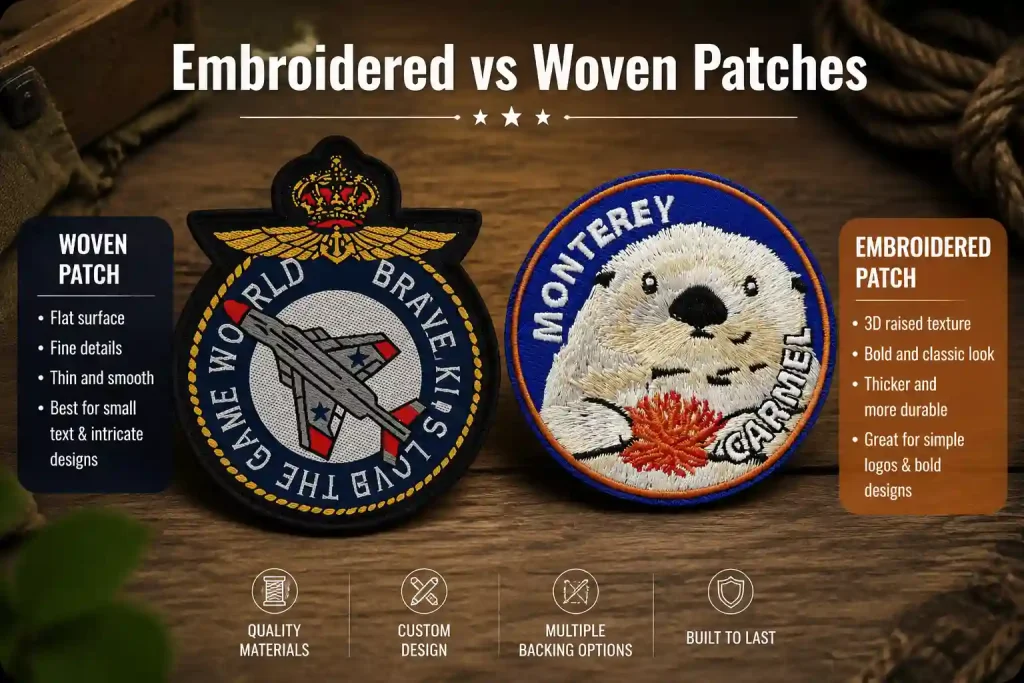
For simple logos, large lettering, and bold outlines, embroidery usually works best. It creates a classic look with more texture and dimension.
For small text, thin lines, detailed artwork, or complex logos, a woven style is often the better choice. Its smooth surface helps fine details appear sharper and easier to read.
Still not sure which option is right for your design? This guide compares their look, level of detail, price, and common uses to help you choose.
Quick Comparison Table
| Feature | Embroidered Patch | Woven Patch |
|---|---|---|
| Look | Raised, textured, classic | Smooth, flat, detailed |
| Best for | Bold logos, large text, simple artwork | Small text, fine lines, detailed logos |
| Texture | Thicker | Thinner |
| Detail level | Medium | High |
| Price | Usually slightly higher | Often more cost-effective |
| Best use | Jackets, uniforms, tactical gear | Fashion labels, hats, brand patches |
What Is an Embroidered Patch?

An embroidered patch is made by stitching a design onto a fabric base with thread. The stitching gives it a slightly raised texture and the classic badge look often seen on uniforms, jackets, hats, school apparel, and club gear.
It works best for logos with bold lettering, clean outlines, and simple color areas. Since the design is built with thread, it also feels more textured and substantial than a flat printed patch.
Key Features
- Raised thread texture: The stitching adds depth and gives the patch a more traditional look.
- Durable for regular use: It holds up well on uniforms, jackets, workwear, and other items that are worn often.
- Flexible backing options: Choose sew-on, iron-on, adhesive, or Velcro depending on how you want to attach it.
- Custom size and shape: The colors, border, shape, size, and backing can all be adjusted to fit your design.
- Best for bold artwork: Large text, strong outlines, and simple graphics usually give the clearest result.
Very small text, thin lines, and complex details may not stitch clearly. For artwork with fine details or gradients, a woven or printed patch may be a better choice.
What Is a Woven Patch?

A woven patch is made with fine threads that are woven together to form the design. Compared with embroidery, it has a flatter surface and a lighter feel, without the raised stitching.
Because the threads are thinner, small text, fine lines, and detailed artwork usually come out much clearer. This makes it a good choice for brand logos, clothing labels, hats, and smaller patch designs.
Key Features
- Sharper details: Small lettering, thin lines, and detailed artwork stay clear.
- Flat finish: The smooth surface gives the design a clean, neat look.
- Lightweight feel: It sits comfortably on clothing and hats without feeling bulky.
- Great for small designs: A good fit for compact logos, labels, and smaller patches.
- Easy to customize: Choose the size, shape, colors, border, and backing that work for your design.
The Difference Between Embroidered and Woven Patches
So, back to the main question: what’s the difference between them?
Although both are fabric patches made mainly from textile threads, they differ quite a bit when it comes to their best uses, production methods, and overall cost.
Design Differences
Embroidery adds texture and dimension, while woven designs focus on fine detail and clean definition. That difference affects how lines, text, spacing, and shading should be handled.
• Lines: Embroidery needs thicker, simpler lines. Woven designs can keep finer details.
• Text: Bold, open fonts work best for embroidery. Woven patches can handle smaller lettering.
• Details: Embroidery often needs a cleaner, simplified design. Woven patches can stay closer to the original artwork.
• Spacing: Embroidery needs more space between elements. Woven designs can use tighter layouts.
• Depth: Embroidery has a raised, textured look. Woven patches look flatter and cleaner.
• Shapes: Small curves and sharp corners may soften in embroidery. Woven designs keep them more precise.
• Shading: Embroidery creates a textured shadow effect. Woven designs can show smoother color changes.
In simple terms, embroidery emphasizes texture and visual impact, while woven designs emphasize clarity and detail.
Differences in Use
Embroidered patches are more common in uniforms and team settings, while woven patches are often used in fashion and branded apparel.
• Uniforms and Teams: Embroidered patches are often used on uniforms, club jackets, team apparel, and public safety gear.
• Identity and Recognition: They are commonly used to show membership, rank, achievement, or group identity.
• Fashion and Branding: Woven patches are often seen on branded clothing, denim, hats, shirts, and merchandise.
• Everyday Products: Both work well on jackets, caps, bags, and other apparel.
• In General: Embroidery is more closely linked to teams and organizations, while woven patches are more common in fashion and retail clothing.
Price Differences
The price difference mainly comes down to how each type is quoted. Embroidered patches are often priced based on stitch count and embroidery coverage, so fuller designs usually cost more. Woven patch pricing is generally more consistent and can be more cost-effective for larger orders.
• Embroidered: The unit price is usually a little higher, especially with heavier coverage.
• Woven: Bulk orders often have a lower unit price, with better savings at higher quantities.
• Keep in mind: Minimum order quantities, setup fees, backing, borders, and shipping can all affect the final price.
In general, woven patches are often more affordable at the same size and quantity, but this is not always the case.
You can also compare VeperPins’ pricing below.


How They’re Made
The main difference is whether the artwork is added to an existing fabric or woven into the material from the beginning.
• Embroidery: A fabric base is secured first, then colored thread is stitched onto the surface layer by layer. Once the design is complete, the piece is cut to shape, the edges are finished, and backing such as iron-on adhesive or Velcro is added.
• Woven: A jacquard loom creates the fabric and artwork at the same time by interlacing colored yarn. The finished strip is then cut into individual pieces, sealed around the edges, and fitted with the chosen backing.
• Key difference: Embroidery places the artwork on top of the fabric, creating a raised texture. Woven artwork becomes part of the fabric itself, giving it a flatter finish.
• Equipment: Embroidery production uses an embroidery machine, while woven patches require a jacquard loom.om.
Embroidery can also be done at home by hand or with a small machine. True woven production usually requires professional equipment and is handled by a manufacturer.

Should I Choose Embroidered or Woven Patches?
Choose embroidered patches if you want a thicker, more traditional patch look. Woven patches are a better choice for small text, fine lines, and detailed designs.
- Teams & Schools: Embroidered patches have a classic team look.
- Military & Public Safety: Embroidery works well for simple designs with larger text.
- Fashion Brands: Woven patches are thinner and sit more naturally on clothing.
- Bands & Streetwear: Choose embroidery for simple logos and woven patches for detailed artwork.
- Kids’ Clothing: Woven patches are softer and less bulky.
Still not sure? Send us your artwork, how you plan to use the patches, and any ideas you have. With over 20 years of experience, we’ll help you choose the right option.
Still Not Sure? Try Both.
Use the same design for a small batch of embroidered and woven patches, then compare the results before placing a larger order.
VeperPins can provide samples for both small and bulk orders, making the process simple and easy from start to finish.
Frequently Asked Questions
Quick answers to common questions about embroidered and woven patches.
Which patch is better for small text and detailed designs?
Woven patches are better for small text, thin lines, and detailed artwork because they use finer threads. Embroidered patches work best for simple, bold logos.
How do embroidered and woven patches feel?
Embroidered patches are thicker and have a raised, textured surface. Woven patches are thinner, smoother, and more flexible.
Which type is more durable?
Both types are durable for everyday use. Embroidered patches are often used on uniforms, workwear, and outdoor gear, while woven patches work well on clothing and fashion products.
Which one costs less?
Pricing depends on the size, quantity, design, and backing option. Embroidered patches may cost a little more because they use more thread, but the final price depends on your design.
Can both patches have iron-on backing?
Yes. Both embroidered and woven patches are available with iron-on, Velcro, adhesive, or sew-on backing.
Do embroidered and woven patches have the same production time?
Not quite. Production time depends on the design, quantity, and backing option. After the artwork and sample are approved, embroidered patches usually take 18–20 days, while woven patches normally take about 15 days.


