
Table of Contents
Designing a custom challenge coin may seem simple at first, but every choice affects the final look, feel, cost, and meaning of the coin. Size, shape, plating, enamel colors, 2D or 3D details, edge style, packaging, quantity, and timeline all play a role in how your finished coin turns out.
This guide is designed to help you make those decisions with confidence. Whether you are creating coins for a military unit, police department, fire department, company, sports team, event, club, or collector project, you will learn how to choose the right design options, understand pricing factors, avoid common mistakes, and prepare your order before production.
If you already have a logo, sketch, reference image, or just a rough idea, this guide will help you understand which options fit your design, budget, and purpose before you place an order.
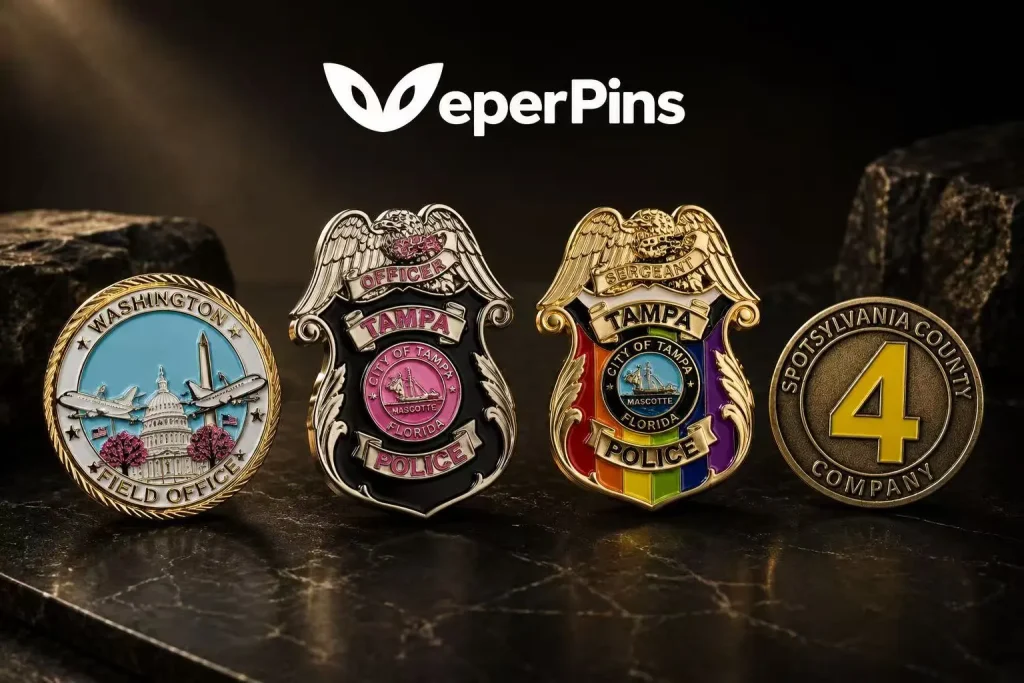
What Are Custom Challenge Coins?
Custom challenge coins are personalized metal coins made with your own logo, emblem, text, date, artwork, or organization identity. They are often used for recognition, membership, awards, team gifts, event keepsakes, and collector projects.
Unlike ready-made coins you may find on Etsy or other marketplaces, custom challenge coins are designed around your specific purpose. You can customize the size, shape, plating, colors, 2D or 3D details, edge style, and packaging to match your brand, team, event, or story.
Different Types of Challenge Coins for Different Uses
Before choosing the size, plating, enamel colors, or 3D details, it helps to first define how your custom challenge coin will be used. Different use cases can influence the artwork style, metal finish, thickness, packaging, and overall budget.
| Use Case | Best For | Common Design Elements |
|---|---|---|
| Military Challenge Coins | Units, veterans, missions, promotions | Unit insignia, motto, rank, aircraft, flags |
| Police Challenge Coins | Departments, officers, ceremonies | Badge, shield, thin blue line |
| Firefighter Challenge Coins | Fire departments, rescue teams | Maltese cross , helmet, truck, station number |
| Corporate Challenge Coins | Employee awards, brand gifts | Logo, slogan, anniversary date |
| Sports Challenge Coins | Teams, tournaments, school awards | Mascot, team logo, championship year |
| Event Challenge Coins | Conferences, clubs, fundraisers | Event logo, date, location |
Military challenge coins often use antique plating and 3D relief for a stronger commemorative look, while corporate coins usually focus on clean logos, polished plating, and premium presentation. For a deeper comparison, see our guide to the different types of challenge coins.
How to Design Custom Challenge Coins
Creating custom challenge coins does not require you to decide every detail at the beginning. Having a clear basic idea is enough to get started. If you are still unsure where to begin, our guide on how to design custom coins can help you understand the basic design steps before production. Once the direction is clear, we can refine the design faster, provide a more accurate quote, and help you better control the final look and budget.
You can usually start with a few simple steps: first, define the purpose of the coin, such as recognition, commemoration, membership identity, event gifts, or team collectibles. Then choose the right size and plan the main design for the front and back sides. Next, based on the complexity of the artwork, you can choose 2D, 3D relief, or printed details, and then decide on plating color, enamel colors, edge style, individual numbering, and packaging options.
Before production begins, the most important step is to review and approve the artwork proof. By checking the proof carefully, you can confirm whether the logo, text, colors, size, front and back layout, and production details are correct, helping avoid unnecessary revision costs after production.

Match Your Artwork to the Right Challenge Coin Style
Different artwork types work better with different production methods. A clean logo does not always need 3D relief, while a portrait, vehicle, building, or detailed scene may look much better with sculpted 3D details. Choosing the right method early can help improve the final look and control the budget.
| Your Artwork Includes | Recommended Option | Why |
|---|---|---|
| Simple logo, badge, or text | 2D soft enamel | Clear lines and strong color separation |
| Portrait, animal, vehicle, or building | 3D relief | Better depth and sculpted detail |
| Photo, gradient, or tiny color details | UV printing | Shows full-color effects that enamel cannot easily create |
| Premium corporate gift | Hard enamel or polished plating | Smooth, refined, and professional look |
| Military or vintage design | Antique plating | Dark recessed areas make relief details stand out |
| Collector series | 3D relief, numbering, and premium packaging | Adds uniqueness and collectible value |
Choosing the Right Challenge Coin Size
The size of a challenge coin affects how much detail you can include, how heavy the coin feels, and how the final design will be used. Smaller coins are better for simple logos, budget-friendly orders, and event giveaways, while larger coins give more space for detailed artwork, 3D relief, double-sided designs, and collector-style presentation.
Use the guide below to compare common challenge coin sizes before choosing the best option for your project.
| Size | Best For | Notes |
|---|---|---|
| 1.5 inch | Simple logos, small budget orders, basic event coins | Limited space for text, best for clean artwork and simple recognition coins |
| 1.75 inch | Classic challenge coins, school coins, club coins, team gifts | A balanced size for cost, details, and everyday custom metal coin projects |
| 2.0 inch | Military coins, police coins, corporate recognition coins | More room for logos, mottos, badges, dates, and double-sided designs |
| 2.25 inch | Premium awards, detailed artwork, department coins, commemorative coins | Good for 3D relief, enamel colors, detailed emblems, and custom challenge coin designs |
| 2.5 inch+ | Collector coins, bottle opener coins, display pieces, special event coins | Higher cost, but stronger visual impact and more space for premium packaging options |

What Are Custom Challenge Coins Made Of?
Material selection is also an important part of creating custom challenge coins. The material affects the weight, texture, durability, production method, and overall cost of the finished coin.
At VeperPins, our standard material for custom challenge coins is zinc alloy. Zinc alloy is a popular choice because it works well for detailed designs, 2D and 3D effects, custom shapes, enamel colors, and different plating finishes. It offers a good balance between quality, design flexibility, and cost.
For customers with different budget or quality requirements, we can also offer iron and brass options.
Iron is usually the most cost-effective option. It is a good choice for simple designs, budget-sensitive projects, large quantities, or promotional coins. Compared with other materials, iron can help reduce the overall cost while still creating a clean custom coin look.
Brass is a more premium material option. It usually has a heavier, more solid feel and a higher-end metal texture, making it suitable for award coins, military commemorative coins, collector series, corporate gifts, and projects where quality and presentation are more important than the lowest price.
If you are not sure which material is best for your project, our team can recommend the most suitable option based on your design, quantity, budget, and expected finish.
What Is the Difference Between 2D and 3D Challenge Coins?
When designing custom challenge coins, one important choice is whether to use a 2D design, a 3D relief design, or a combination of both.
Simply put, 2D challenge coins focus more on clarity. The artwork is usually created with raised and recessed metal levels, making it suitable for logos, text, badges, shields, and simple emblems. The lines are cleaner, the details are easier to read, and it works well for designs that need to present information clearly.
3D challenge coins focus more on depth and detail. The surface has more natural raised and recessed contours, making it better for faces, animals, vehicles, buildings, commemorative scenes, and other complex artwork. Compared with 2D, a 3D design looks more realistic and premium, making it a good choice for collectible or high-end commemorative projects.
For some complex designs, you can also combine 2D and 3D effects, or use UV printing to show full-color images, gradients, and tiny details that are difficult to achieve with enamel alone.
| Type | Suitable Designs | Final Effect |
|---|---|---|
| 2D Challenge Coins | Logos, text, badges, shields, and simple emblems | Clear raised and recessed metal layers with sharp lines |
| 3D Challenge Coins | Faces, animals, vehicles, buildings, and detailed artwork | More depth, smoother details, and a realistic sculpted look |
| 2D + 3D Coins | Military coins, collector coins, and designs with both text and detailed images | Combines clear text with deeper 3D details |
| UV Printed Coins | Full-color images, gradients, photos, and very small details | Bright photo-like colors that are difficult to create with enamel alone |

Soft Enamel vs Hard Enamel vs Die Struck vs Printed Coins
When making custom challenge coins, the production process affects the surface, texture, color, and overall style of the finished coin. Many customers are not sure whether they should choose soft enamel, hard enamel, die struck, or UV printing, so it helps to understand the basic difference first.
Soft enamel coins are a popular choice for bold colors, military coins, police coins, event coins, and team designs. The metal lines are raised, while the enamel colors sit slightly lower, creating a textured feel with clear color separation.
Hard enamel coins have a smoother and more polished surface. They are often used for premium gifts, brand coins, anniversary coins, and collectible projects because the final look feels more refined and high-end.
Die struck coins do not use enamel colors. Instead, the design is created directly in metal, often with antique gold, silver, bronze, or brass finishes. This process is ideal for classic, formal, and traditional challenge coin designs.
UV printed coins are best when the artwork includes photos, gradients, tiny details, or full-color images. Printing can show details that are difficult to achieve with enamel alone, making it a good option for complex artwork.
How to Choose Plating Based on Your Artwork Style
Plating affects the overall style, contrast, and perceived value of custom challenge coins. When choosing a plating finish, you should not only look at the color, but also consider the coin’s purpose, artwork details, and the overall feeling you want the finished piece to have.
| Artwork Style | Better Plating Choice | Reason |
|---|---|---|
| 3D military emblem | Antique gold / antique silver | Helps show recessed depth and raised relief details more clearly |
| Modern logo | Polished silver / black nickel | Creates a clean, sharp, and high-contrast appearance |
| Premium award coin | Gold / dual plating | Looks more formal, valuable, and suitable for gifts or ceremonies |
| Collector series | Antique + dual plating | Adds more detail, depth, and collectible value to the final coin |
| Youth or event design | Rainbow plating | Makes the coin more colorful, eye-catching, and memorable |
Edge Options, Numbering, Bottle Openers, and Packaging
Beyond size, plating, and color, add-on options can also increase the overall value of your custom challenge coins. The right edge style, numbering, functional feature, or packaging can make the finished piece look more complete and more suitable for gifts, awards, or collectibles.
Edge options can add more detail to the coin. For example, a rope edge works well for traditional military or commemorative designs, while a reeded edge gives the coin a more classic coin-like feel. Oblique line, cross cut, chain edge, and spur edge can make the outer rim look more decorative and powerful. For special designs, you can also choose a custom edge to better match the overall theme.
Edge engraving and sequential numbering are good choices when you want to emphasize exclusivity. Adding a motto, date, organization name, or limited-edition text on the edge can make the coin more meaningful. Sequential numbering is especially useful for member coins, collector coins, limited-edition projects, or team series, giving each piece its own unique identity.
If the coin is made for bars, clubs, events, promotional gifts, or casual gatherings, you can also add a bottle opener function. This makes the coin not only memorable but also practical, making it a good option for event giveaways, brand promotions, or collectible merchandise.
Packaging also affects the first impression when customers receive the product. A plastic bag is suitable for budget-friendly orders, while a backing card works well for retail display or brand presentation. A velour bag feels more refined and is suitable for gifts. Acrylic boxes and velvet boxes are better for awards, VIP gifts, ceremonies, or premium collector projects.

How Much Do Custom Challenge Coins Cost?
The cost of custom challenge coins depends on several factors, including size, quantity, design complexity, production process, packaging, and delivery timeline. In general, the larger the quantity, the lower the unit price. Larger sizes and more detailed designs usually increase the overall cost.
For example, for a common 1.75 inch custom challenge coin, an order of 100 pieces may cost around US$3.63 per coin. In addition, custom challenge coins usually require a mold fee, which is commonly around US$125. The final price should be confirmed based on the actual design and production requirements.
The main pricing factors include:
Size: Larger coins use more material and usually cost more.
Quantity: Higher quantities usually reduce the unit price.
One-sided or double-sided design: Double-sided designs require more production work and time.
Soft enamel or hard enamel: Different enamel processes affect the surface finish and cost.
2D or 3D details: 3D relief details usually cost more than standard 2D designs.
Plating: Gold, silver, antique gold, antique silver, black nickel, rainbow plating, or dual plating can all affect the final price.
Edge design: Rope edge, oblique line edge, reeded edge, chain edge, or custom edge options may add extra cost.
Mold fee: Each new custom design usually requires a separate mold.
Packaging: Plastic bags, backing cards, velour bags, acrylic boxes, and velvet boxes have different costs.
Shipping deadline: Rush production or expedited shipping may also increase the total cost.
Because of these factors, the most accurate price should be based on your artwork, size, quantity, and production details. For budget-sensitive projects, you can reduce costs by choosing a smaller size, simplifying 3D details, selecting standard plating, or using basic packaging.

Choose a Budget Path for Your Custom Challenge Coins
If you want to control costs, you can choose a common basic setup, such as 1.75 inch size, 2D design, soft enamel, standard plating, and plastic bag packaging. This option is suitable for budget-sensitive projects, larger quantities, or designs mainly based on logos, text, and simple artwork.
If you want a more balanced option, you can consider 2.0 inch size, which is one of the most popular sizes, along with a double-sided design, antique plating, soft enamel, and a standard edge. This setup offers a good balance between price and appearance. It allows more design details without making the cost too high, making it suitable for companies, schools, police departments, sports teams, and event projects.
If you want the finished coins to look more premium, you can choose 2.25 inch or larger size, 3D relief, dual plating, edge engraving, and velvet box packaging. This option is better for awards, VIP gifts, military commemorative projects, premium corporate gifts, or important ceremonies.
For collector series, it is recommended to consider 3D sculpting, individual numbering, antique plating, and custom packaging. These details can increase exclusivity and collectible value, making them ideal for limited-edition projects, fan collectibles, membership series, or commemorative sets.
For event giveaways or promotional gifts, you can choose a simple logo, standard size, larger quantity, and basic packaging. This helps reduce the unit cost while still giving the finished piece basic brand value and commemorative meaning.
When Certain Challenge Coin Options May Not Be Right for Your Design
Not every custom process is suitable for every coin design. When choosing a production method, you should consider the colors, details, relief depth, and final use of your artwork instead of simply choosing the option that sounds more premium.
For example, if your artwork includes many colors, gradients, or tiny color areas, hard enamel may not be the best choice. Hard enamel works better for designs with clear color separation and defined metal lines. If the artwork has many colors or complex details, soft enamel or UV printing may be a better option because they can preserve the color effect more effectively.
Many customers prefer high-relief 3D designs because they look more dimensional and premium. However, if you want the raised 3D areas to also include rich colors, enamel alone may not fully meet your needs. In this case, 3D relief + UV printing is usually a better solution because it can keep the sculpted depth while showing more colors and details.
If your design is very complex, such as portraits, buildings, vehicles, animals, detailed emblems, or a lot of text, it is usually not recommended to choose a very small size. To make all details clearer, you may need to increase the coin size, such as choosing 2 inch, 2.25 inch, or larger.
Simply put, the right process is not fixed. It depends on your artwork. The more complex the design is, the more important it is to balance size, color process, relief depth, and plating choice so the final coin can look closer to your expected result.
Custom Challenge Coin Production Process
Steps 1–5 are where you’ll work closely with the VeperPins team.
Step 1: Send Your Idea or Artwork
You can send your logo, sketch, reference image, or simple idea through our quote page. We will review your design needs and understand the basic details of your project.
Step 2: Get a Quote
Based on the size, quantity, production process, design complexity, packaging, and delivery timeline, we will prepare a price and recommend a suitable manufacturing solution.
Step 3: Pay the Artwork Deposit
After the quote is confirmed, a US$50 artwork deposit is required. This deposit will be applied toward your final payment.
Step 4: Receive the Digital Artwork Proof
Our designer will create a digital artwork proof for your review. You can check the front and back layout, text, colors, size, plating, 2D/3D effects, and other production details before manufacturing begins.
Step 5: Revise and Approve the Design
If any changes are needed, they can be adjusted during the artwork stage. Production will only begin after the final artwork is approved.
The following Steps 6–11 provide a brief overview of the production process once your order enters our factory.
Step 6: Mold Making
Once the artwork is approved, we create the production mold based on the final design.
Step 7: Coin Forming
We use the appropriate production method for your design and selected material to form the coin’s basic shape and details.
Step 8: Surface Finishing
The coins receive the approved plating, antique, or two-tone finish.
Step 9: Adding Color
If the design includes color, enamel or UV printing is added according to the approved artwork.
Step 10: Quality Inspection
After production, we check the colors, text, surface, and overall appearance against the approved design.
Step 11: Packaging and Shipping
Once the coins pass inspection, they are packed according to the order requirements and prepared for shipping.

How to Prepare Your Artwork or Design Brief
You don’t need finished artwork to request a quote. Send us whatever you have—a logo, sketch, reference image, or rough idea—along with your quantity, size, what you want on the front and back, plating, enamel colors, 2D or 3D effects, edge style, packaging, and delivery deadline.
The more details you share, the more accurately we can quote your project and prepare your artwork proof. If you’re unsure about any of these options, we’ll recommend the best approach based on your design and budget before production begins.
Create Your Custom Challenge Coins with VeperPins
Creating a coin starts with a clear purpose—what it should represent, who it is for, and how you want the finished piece to look and feel. Once the idea is clear, an experienced custom coin supplier can refine the artwork, recommend the right production method and finish, and make sure the final result matches the approved design.
VeperPins supports you from the first concept through final delivery. Send us whatever you have, and we’ll help turn it into a production-ready design, prepare an accurate quote, and provide an artwork proof for your approval before production begins.
FAQ About Custom Challenge Coins
Have questions before ordering custom challenge coins? Here are some common details about minimum order quantity, mold fees, mixed processes, reorders, mold storage, and production time.
Is there a minimum order quantity for custom challenge coins?
No. VeperPins supports flexible order quantities, so you can choose the quantity that fits your project needs.
However, in most cases, the more coins you order, the lower the unit price will be. If you want to control your overall budget, increasing the order quantity is usually an effective way to reduce the cost per coin.
Do custom challenge coins require a mold fee?
In most cases, a new custom design requires a separate mold, so a mold fee may apply. The mold fee depends on the coin size, design complexity, and production requirements.
However, if your order reaches 300 pieces or more, we can waive the mold fee. Prices may also vary by size, so you can check our Coins Pricing page or contact us for a more accurate quote.
Are mold fees the same for different coin sizes?
No. Larger challenge coins usually require higher mold costs. Different sizes, shapes, design details, and production requirements can all affect the final mold fee.
If you are not sure which size to choose, you can send us your artwork, quantity, and budget. We can recommend a suitable size and quote based on your project needs.
Can soft enamel and hard enamel be combined on the same challenge coin?
Yes. Custom challenge coin processes can be combined flexibly. In addition to combining soft enamel and hard enamel, you can also choose die struck + enamel, UV printing + enamel, or 3D relief + printing.
Different process combinations work better for different design effects. If your artwork includes clean metal lines, complex colors, gradients, photos, or 3D details, we can recommend a suitable process combination based on your design.
Can I order custom challenge coins if I do not have finished artwork?
Yes. You do not need to have a finished design file before requesting a quote. You can send us your logo, sketch, reference image, text, theme idea, or project purpose, and our design team can help turn it into a production-ready artwork proof.
If you are not sure about the size, plating, colors, or 2D/3D effect, you can also tell us your budget and use case. We will suggest suitable options for your project.
Can I see the design proof before production?
Yes. Before production begins, we will provide a digital artwork proof for your review. You can check the front and back design, text, colors, size, plating, 2D/3D effects, edge options, and other production details.
Production will only begin after you approve the final artwork. This helps avoid spelling errors, color issues, wrong size choices, or incorrect production details.
How long will VeperPins keep my mold?
VeperPins will store your mold for free for 2 years. If you need to reorder the same design later, we can reuse the existing mold, helping you save both mold cost and production time.
Do I need to pay the mold fee again for reorders?
If your mold is still within the storage period and the design, size, and mold structure remain the same, you generally do not need to pay the mold fee again.
If you need to change the size, shape, main artwork, 3D structure, or any detail that affects the mold, a new mold may be required and a new mold fee may apply.
Can the same design be made with different plating or color versions?
Yes. The same basic design can be made in different versions, such as antique gold, antique silver, black nickel, polished gold, dual plating, or different enamel color versions.
Please note that if the design structure does not change, the same mold can usually be used. If the artwork structure, text, shape, or 3D details change, a new mold may be required.
How long does it take to receive custom challenge coins?
In general, custom challenge coin production takes about 15–20 days. If the design includes very complex 3D relief details, multiple plating effects, special edges, complex colors, or other special processes, production may require about 8 extra days.
Shipping usually takes about 3–5 days, depending on the destination, shipping method, and customs clearance. If you have an event date or delivery deadline, please let us know when requesting a quote so we can recommend a suitable production and shipping plan.


